-
Gyeongsangbuk-do Office of Education runs a global citizenship education program linking local resources Teams of domestic and international students serve as one-day teachers at local elementary, middle, and high schools Unique classes featuring cultures, languages, and foods from around the world are popular [June 14, 2024] On the afternoon of June 12, joyous cheers erupted from Gyeongsan Middle School as classes were in full swing. Claudia Marie (27) from the UK, a language student at YU Korean Language Education Center, and JEONG Woo-hoon (26), a senior in the Department of Korean Language and Literature at YU, stepped in as one-day teachers. They conducted a class themed on the geography, food, language, and festivals of the UK.The class was presented by Marie, with JEONG providing support materials. The students responded enthusiastically to the class led by a foreign university student. Marie expressed her thoughts, saying, "I was happy to introduce British culture to Korean students. I hope they gained a lot of knowledge about the UK." JEONG added, "I was worried despite meticulously preparing the class materials, but the students' positive reactions made the class enjoyable." KIM Young-ran (48), a teacher in charge of international exchanges at Gyeongsan Middle School, commented, "The university students who came as one-day teachers were well-prepared, which encouraged active student participation. It was very helpful for the students to directly hear and engage in a class about another country's culture from a local university student. I hope there will be more opportunities for students to learn from students from various countries in the future." The classes conducted by these students are part of the '2024 Regional Resource Linked Global Citizenship Education' program organized by the Gyeongsangbuk-do Office of Education. This program is designed by the Gyeongsangbuk-do Office of Education to provide local elementary, middle, and high school students with the opportunity to naturally communicate with international university students during class time, experience world cultures, and develop a global mindset. For this program, one international student and one Korean student pair up to teach. YU has formed 18 teams with international students from 10 countries and Korean students, teaching at a total of 69 schools in the Gyeongsangbuk-do region until December. SON Sang-beom, Director of International Affairs at YU, said, "YU hosts over 1,256 international students from 62 countries enrolled in degree programs and annually welcomes about 124 exchange students from approximately 19 countries. Based on YU's glocal educational capabilities, we will continue to take the lead in various programs that can coexist with the local community."
- PR team
- 2024. 06. 28
- 2024. 06. 14
- 1381
-
Ranked 35th in Leadership and 37th in Social Responsibility among 1,072 universities worldwide Acknowledged for achievements in nurturing Saemaul leaders and global leadership through Saemaul Studies of president CHOI Dedicated to national development and global prosperity [June 14, 2024] <Yeungnam University campus> YU (President CHOI Oe-chool) was ranked 35th in the world and 3rd in Korea in the Leadership category and 37th globally in the Social Responsibility category in the ‘2024 World University Rankings for Innovation (WURI)’ announced at the 4th Hanseatic League of Universities (HLU) Conference held at Franklin University in Switzerland on June 7. WURI, organized by the Institute for Competitiveness, is co-hosted by HLU, the Swiss Institute of Industrial Policy, the UN Institute for Training and Research (UNITAR), and the Taylor Institute at Franklin University Switzerland. Since 2020, these rankings have evaluated universities based on case-by-case qualitative assessments of their innovative programs, highlighting not only traditional academic achievements but also responses to industrial and societal needs with practical and innovative outcomes. In 2024, the rankings evaluated 2,880 cases from 1,072 universities globally. WURI ranks the top 300 global universities overall and the top 100 universities in 13 specific areas. Among them, YU was ranked in the Leadership category, an indicator of innovation means, and in the Social Responsibility category, an indicator of innovation. In the leadership category, YU received high praise for its innovative leadership in education and community development. This recognition stems from the university’s efforts to develop the Saemaul Movement and Korea’s development experience into sustainable development policies, including modern adaptations such as 'Saemaul 2.0' and 'Smart Saemaul.' Furthermore, YU’s leadership was acknowledged for not only institutionalizing the Saemaul Movement academically but also for its global contribution to human society through initiatives like PSPS, the Institute for International Development Cooperation, various agreements for spreading Saemaul studies, the Global Saemaul Forum, and community development consulting. In the social responsibility category, YU was recognized for its efforts through PSPS. YU has been instrumental in educating future leaders of developing countries on the Saemaul Movement, Korea’s development experience, sustainable development education, and leadership training. The successful application and substantial growth demonstrated by students who studied Saemaul studies at YU and returned to their home countries also contributed to the high evaluation. President CHOI Oe-chool stated, “Being highly rated in the Leadership and Social Responsibility categories is the result of our continuous efforts to nurture talent that contributes to the mutual growth of developing countries and South Korea. In a rapidly changing social environment and the crisis faced by universities, new leadership is necessary to promote sustainable growth. It is important to create an environment where cooperation and innovation can drive national development and global community prosperity, and YU's efforts in this regard have been highly evaluated. We will continue to support all academic fields at YU to elevate educational and research outcomes to a global level.” Additionally, in December last year, YU was recognized for its efforts in leading sustainable development in developing countries through the Korean-style ODA project via PSPS, receiving the Porter Prize in the Effectiveness of 10th CSV/ESG Projects category, co-hosted by the Institute for Industrial Policy Studies, Dong-A Ilbo, and Channel A.
- PR team
- 2024. 06. 28
- 2024. 06. 14
- 1540
-
Under the theme 'Sharing Korea's Development Experience, the Key to Humanity's Common Good: Focusing on the Case of Saemaul International Development' Attended by Guinea's Minister of Agriculture and Livestock, international organizations, high-ranking officials from various countries, NGOs, and academia Exploring solutions to global issues through the Smart Saemaul Movement [May 29, 2024] YU (President CHOI Oe-chool) hosted the Global Saemaul Forum to commemorate its 77th anniversary, the first time in eight years. Under the theme 'Sharing Korea's Development Experience, the Key to Humanity's Common Good: Focusing on the Case of Saemaul International Development,' the forum aimed to share a new educational paradigm for sustainable global development and present the university's vision for fostering talent contributing to human society's advancement. Staff of international organizations, ambassadors to Korea, senior public officials, and professionals of academic societies and NGOs participated in the global forum held in LEE Si-won Global Convention Hall of YU Cheonma Art Center for two days on the 28th and 29th and the forum was broadcasted in real time through YouTube. <President CHOI Oe-chool delivers a welcome speech at the opening ceremony of the Global Saemaul Forum commemorating the YU 77th anniversary> At the opening ceremony on the 28th, President CHOI Oe-chool of Yeungnam University, along with university officials, LEE Cheol-woo, Governor of Gyeongsangbuk-do, KIM Jang-ho, Mayor of Gumi, CHO Hyun-il, Mayor of Gyeongsan, Felix Lamah, Guinea's Minister of Agriculture and Livestock, Jadambaa Bat-Erdene, Member of Parliament of Mongolia, Dessie Dalkie Dukamo, Ambassador of Ethiopia, Nkubito Manzi Bakuramutsa, Ambassador of Rwanda, Towfik Jemal Ali, President of Werabe University in Ethiopia, Rotana Kieng, President of Western University in Cambodia, and LIM Hyoung-jun, Head of the WFP Office in Guinea, attended to grace the occasion. <Clockwise from top left: Felix Lamah, Guinea's Minister of Agriculture and Livestock; Jadambaa Bat-Erdene, Member of Parliament of Mongolia; Nkubito Manzi Bakuramutsa, Ambassador of Rwanda; Dessie Dalkie Dukamo, Ambassador of Ethiopia> In his congratulatory speech, Felix Lamah, Guinea's Minister of Agriculture and Livestock, said, "Through the Saemaul Movement, every region in Korea was able to develop, and this experience is a model for Africa. We aim to apply the successes of the Saemaul Movement to promote development in Guinea," celebrating the global forum's commencement. Following this, Jadambaa Bat-Erdene, a Member of Parliament of Mongolia, shared, "After becoming a member of parliament, we implemented the 'New Village Project' inspired by the Saemaul Movement in Mongolia, which reduced unemployment, increased the number of businesses, and boosted local employment and income. We plan to continue learning from and collaborating with various Korean institutions." Ethiopian Ambassador Dessie Dalkie Dukamo said, "Yeungnam University is the heart of the Saemaul Movement, which has become an international policy through global cooperation, leading to the eradication of poverty. The education I received at Yeungnam University about the Saemaul Movement 9 years ago was very helpful in my role as a regional leader. The Saemaul Movement is a model and lesson that developing countries should learn from." Rwandan Ambassador Nkubito Manzi Bakuramutsa remarked, "Rwanda has adopted the Saemaul Movement as a development policy for sustainable national growth, and it has led to positive changes in Rwanda, especially aiding post-war reconstruction." <Keynote address by LEE Cheol-woo, Governor of Gyeongsangbuk-do, at the Global Saemaul Forum> The Global Saemaul Forum officially began with a keynote address by LEE Cheol-woo, Governor of Gyeongsangbuk-do, on "Hope for Eradicating Global Poverty through Sustainable Development: Globalizing the Gyeongsangbuk-do Saemaul Movement." Governor LEE emphasized Gyeongsangbuk-do's role as the birthplace of the Saemaul Movement and its duty to share Korea's experience in overcoming poverty with the international community. He also emphasized the need to promote the globalization of the Saemaul Movement, which has been recognized by international organizations as a key model for ending absolute poverty and hunger, and stressed the need to provide content that is differentiated from the existing development assistance models of developed countries. <Students from Park Chung Hee School of Policy and Saemaul (PSPS) sing the 'Saemaul Song' at the Global Saemaul Forum> From the afternoon of the 28th, the forum continued with three sessions.The first session, chaired by former KOICA Chairman SOHN Hyeok-sang, focused on "Traces of Global Co-Prosperity: Sharing Yeungnam University's Saemaul International Development Achievements," with a keynote presentation by LIM Hyoung-jun, Head of the WFP Office in Guinea, followed by thematic presentations from Felix Lamah, Guinea's Minister of Agriculture and Livestock, KIM Jang-ho, Mayor of Gumi, and LEE Byung-wan, Dean of the Park Chung Hee School of Policy and Saemaul (PSPS). The second session, chaired by former KOICA Chairman KIM Young-mok, revolved around "The Future of Global Co-Prosperity through the Smart Saemaul Movement: Glocal Revolution." Keynote speaker LEE Seung-jung, CEO of the Saemaul Foundation, was followed by presentations from LIM Byeong-jin, Secretary-General of NEAR, Towfik Jemal Ali, President of Werabe University, and HAN Dong-geun, Vice President of Business Strategy at Yeungnam University. On the 29th, the third session, chaired by LEE Jeong-ju, Vice Dean of PSPS, was divided into two parts. The first part, "Best Saemaul Practice," featured presentations by JEONG Jin-young, Professor of Environmental Engineering at Yeungnam University, SEO Yong-won, Professor of Construction System Engineering, and Professor Abjalahmed Khan. The second part, chaired by YU Honorary Professor KIM Ki-soo, included presentations from Aida Musaeva and Vidia Lestari, KOICA training project awardees, KIM Song-yi, Head of the Saemaul Movement Support Department in Gyeongsangbuk-do, and LEE Ju-Hyung, Director of the YU Institute for International Development Cooperation. <A vocal performance celebrates the YU's 77th anniversary and the Global Saemaul Forum> YU President CHOI Oe-chool said, "This forum is a meaningful event where Yeungnam University, which has been producing leaders driving Korea's development for 77 years, shares and presents new directions for the Saemaul Movement to nurture talents contributing to sustainable global co-prosperity. Fostering talents contributing to human society's advancement is no longer a choice but a duty to the international community. We hope this forum serves as an opportunity to assess and share Yeungnam University's efforts to academicize Korea's development experience and the Saemaul Movement and disseminate them worldwide. Moreover, we aspire to address pressing global and domestic issues through the new leap of the Saemaul Movement by incorporating values of diligence, self-help, cooperation, sharing, service, and creativity into 'Saemaul Spirit 2.0' and promoting 'Smart Saemaul' tailored to the times. We hope this serves as an opportunity to present a model for nurturing global contributors and leaders who will build a more dignified and attractive nation." In his welcome speech, President CHOI Oe-chool proposed to Governor LEE Cheol-woo, Mayor KIM Jang-ho of Gumi, and Mayor CHO Hyun-il of Gyeongsan to hold the Global Saemaul Forum biennially in Gyeongsangbuk-do, akin to the Davos Forum, to contribute to global co-prosperity as a widely shared K-Policy like K-Culture. Governor LEE responded positively before his keynote address, stating, "Gyeongsangbuk-do will support hosting the Global Saemaul Forum, a global event like the Davos Forum, attracting worldwide attention and promoting Hallyu (Korean Wave) policy."
- PR team
- 2024. 06. 13
- 2024. 05. 29
- 2546
-
- PR team
- 2024. 06. 13
- 2024. 06. 07
- 2481
-
'Global Harmony' Event Boosts Community Spirit Among Local and International Students Over 200 Participants, Including International Students from 39 Countries Four teams consisting of sharing, volunteering, creation, and contributing for 15 competitions including six-person-seven-legged race [May 23, 2024] YU (President CHOI Oe-chool) held the '77th Anniversary International Students Sports Festival'. This event was prepared to enhance a sense of belonging as YU students regardless of native and foreign students and to improve a sense of global community among young people around the world who will lead the global era. The sports festival, held on May 22 at Yeungnam University's artificial turf soccer field, saw participation from over 200 students, including international students from 39 countries such as Ghana, Mongolia, Vietnam, Spain, Sierra Leone, China, and Thailand. Participants included undergraduates, Korean language education center trainees, graduate students, and students from PSPS. The students competed in four teams: Sharing, Service, Creativity, and Contribution, reflecting Yeungnam University's vision of contributing to the prosperity of humanity as a creative innovation university. The festival began with an opening declaration, an oath from the team representatives, and various performances from the Chinese and Vietnamese student associations and a choir of PSPS, enhancing the festive atmosphere. YU President CHOI Oe-chool said, "I feel proud and delighted to see students from all over the world gather at Yeungnam University to pursue your dreams with dedication. I am confident that the time you spend here will become a valuable foundation when you become global leaders contributing to the global community in the future. I hope that international students, who have been focusing on their studies in various fields, will enjoy this sports festival to build friendships and camaraderie. Study hard at Yeungnam University, gain diverse experiences, and become individuals who contribute to human society." Luc Van Der Wal, a third-year student from the Netherlands in the Department of International Development at PSPS, said, "I wanted more opportunities to interact and communicate with students from different countries, and this sports festival provided a great chance to make friends and build camaraderie through sports." Fujiyama Mero, a fourth-year student from Japan in the Department of Korean Language and Literature, who participated in the festival as part of the Sharing team, expressed gratitude to the university for organizing such an enjoyable experience for international students. She particularly enjoyed the group jump rope and tug-of-war, highlighting the joy of creating precious memories with friends outside the classroom on a sunny day. On this day, the participants of the sports competition competed in 15 items, including dodgeball, balloon tower building, tug-of-war and six-person-seven-legged race until 4 pm and Volunteering Team won the final championship and received a cash prize of KRW 5 million.
- PR team
- 2024. 06. 13
- 2024. 05. 23
- 1808
-
11 Alumni from CNSi Club Visit School to Show Support CNSi Club, Established by Professor SA Jong-yeob in 1993 to Nurture Software Talents Dedicated to University Development and Nurturing Glocal Talents [May 28, 2024] <YU Mechanical Engineering Department CNSi Club alumni have donated 30 million won for the development of their alma mater.> YU Mechanical Engineering Department CNSi Club alumni have donated 30 million won for the development of their alma mater. On the 25th, 11 alumni who were active in the CNSi Club from the classes of '89 to '93 visited the university for the first time in 30 years. They met with YU President CHOI Oe-chool and handed over the donation, requesting it be used for the development of the university and the support of current mechanical engineering students. CNSi Club was established in 1993 by Professor SA Jong-yeob of the Mechanical Engineering Department to enhance students' practical skills through participation in competitions, industry-academia cooperation programs, and various project experiences for those interested in software development. Since its inception, the club has amassed numerous awards in contests hosted by schools and companies due to the passionate guidance of the advisor and the challenging spirit of the students. These alumni, who are now thriving in various sectors of society, visited the school to express their gratitude to their advisor and support their juniors. <CNSi Club presented flowers of gratitude to Prof. SA Jong-yeob>. Mechanical Engineering alumnus LIM Woo-taek ('90) said, "First of all, I would like to thank Professor SA Jong-yeob for establishing the club and supporting the students in every way possible. The intense discussions, brainstorming, and project activities with the club seniors and juniors 30 years ago have shaped who we are today. We decided to give back a portion of what we received from our alma mater and Professor SA. We hope this will aid the development of the mechanical engineering juniors and we will continue to support our alma mater." In response, YU President CHOI Oe-chool said, "As a president, I am grateful to the numerous alumni who support their alma mater. I believe the presence of alumni who are active in various sectors of society enhances our university's capabilities and prestige. YU is committed to change and innovation in a rapidly changing university environment. We will dedicate ourselves to educating glocal talents who will lead national development and contribute to global community prosperity in line with the support of our alumni."
- PR team
- 2024. 06. 13
- 2024. 05. 28
- 1793
-
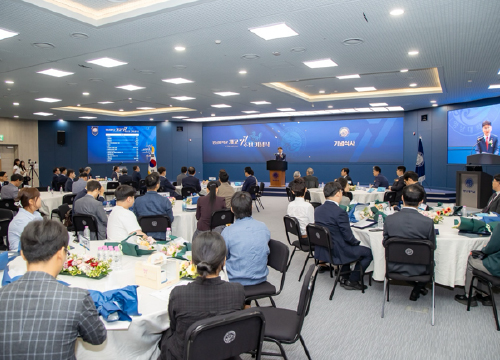
“Moving from cultivation of pillars for national revival to cultivation of talents for global contribution” Awards for excellent teaching professors, exemplary staff, and sharing, volunteering, and creativity, etc. “Songam LEE Jong-woo Achievement Award” for university development and innovation through education and research [May 14, 2024] <On the 14th, a ceremony commemorating the 77th anniversary of the opening of YU was held at the Chunma Art Center of YU.> <Congratulatory message by President CHOI Oe-chool of YU> YU (President CHOI Oe-chool) held 77th Anniversary Ceremony. 77th Anniversary Ceremony was held in LEE Si-won Global Convention Hall of YU Chunma Art Center at 11 am on the 14th and Mayor CHO Hyun-il of Gyeongsan-si, former Chairman JEONG Tae-il of YU General Alumni Association, Vice-President KIM Ki-man of Daegu Bank, President HA In-seong of Gyeongbuk Techno Park, Chairman HAN Jae-sook and Director KIM Jin-sam of Yeungnam Educational Foundation, 13th President LEE Hyo-soo of YU, 15th President SEO Gil-soo of YU, Honorary Chairman LEE Gwang-sik of Professor Association, former Honorary Chairman KIM Bong-sik of Professor Association, Chairman JEONG Jae-hak of Professor Association, Chairman PARK Young-bong of Employee Labor Union, and Chairman YOO Sang-won of Student Council, etc. attended the ceremony to celebrate the 77th anniversary of YU. .LEE Joo-ho (Deputy Prime Minister and Minister of Education, KIM Kwan-yong (Senior Vice-Chairman of National Unification Advisory Council), LEE Cheol-woo (Governor of Gyeongsangbuk-do), President PARK Sang-gyu (Chairman of Korea Council for University Education), BYEON Chang-hoon (Chairman of Korean Association of Private University Presidents), LEE Seung-hwan (President of Gumi University), PARK Jeong-gwan (Chairman of Seoul General Alumni Association), LEE Jong-woo, LEE Si-won, PARK Won-hoon, and LEE In-ho (Directors of Yeungnam Educational Foundation), LEE Cheon-soo (Chairman of Daekyo Cultural Foundation), Chairman PARK Yun-kyung (Chairman of Daegu Chamber of Commerce and Industry), Chairman HWANG Byeong-woo (Chairman of DGB Financial Group), NOH Hee-chan (President of Samil Spinning Co., Ltd and former Chairman of Chamber of Commerce Chairman), and KANG Gu-young (CEO of Korea Aerospace Industries: KAI) sent congratulatory videos and congratulatory messages to celebrated the 77th Anniversary. <Commemorative speech by HAN Jae-sook (Chairman of Yeungnam Educational Foundation)> Chairman HAN Jae-sook of Yeungnam Educational Foundation said in the commemorative speech, “Despite the efforts and achievements of the Chunma Family, it is a time that the fate of the university is constantly being tested by waves of great change surrounding the university. I hope that all members of the university cherish the founding spirit deeply in their hearts and YU will unite and do its best in development of the university in order to take a powerful leap forward as a Glocal university to lead new changes and innovations at the center of the regional innovation ecosystem.” President CHOI Oe-chool of YU said in the commemorative message, “I am grateful to everyone who has made YU what it is today, including President PARK Chung-hee, the founder of Yeungnam Educational Foundation. Despite the crisis of declining school-age population, all members of YU worked with one mind and one will to develop the university, and as a result, we achieved remarkable results in various world university rankings and financial support projects. We will do our best to prepare for the designation of the “Glocal University 30 Project” in the future. At the 77th Anniversary, YU is expanding Yeungnam Educational Foundation with Saemaeul spirit of “You can do it” under the slogan “Focus in the future, challenge in the world.” “We will maintain the founding spirit and identity of the academy and will do our best to cultivate the talents required by the times and develop it into a prestigious private academy that stands tall in the world.” At the ceremony, awards were given to professors and staff who have worked hard to develop the university in areas such as education, research, and administration and to students who have worked hard to contribute to society and develop the community. Long-term service awards were given to 107 persons, Excellent Chunma Honors Lecture Awards were given to 7 professors, Excellent Lecture Awards were given to 16 professors, Excellent Research Awards were given to 14 persons, Songam LEE Jong-woo Achievement Awards were given to 4 persons, Exemplary Staff Awards were given to 9 persons, and Sharing, Volunteering, and Creativity Awards were given to 7 persons, with congratulations. <Faculty and staff received Long-Term Service Awards on behalf of long-term service faculty and staff> <Faculty who received the Chunma Honors Teaching Excellence Awards> <Faculty received Excellent Research Awards> <Staff received Model Employee Awards> In particular, at this year's ceremony, in addition to the awards to faculty and staff, Sharing, Volunteering, and Creativity Awards were given to 7 students who have exerted a positive influence on the community by realizing the values of sharing, volunteering, and creativity, adding to the meaning of the ceremony with all members of the university together and Songam LEE Jong-woo Achievement Awards were given to 4 professors who contributed to university development and innovation through education and research. The award has been given since last year with use of the development fund donated by Chairman LEE Jong-woo of Korea Former Co., Ltd who is the chairman of Yeungnam Educational Foundation. <Teachers who received the Songam LEE Jong-woo Achievement Awards> <Students received Sharing, Volunteering, and Creativity Awards> Prior to the ceremony, an unveiling ceremony was held at Chunma Honors Park with attendance of key faculty members, including President CHOI Oe-chool, to commemorate the 77th anniversary of the school's founding. Jeongipumsong, a successor tree grown from the seeds of Songnisan Jeongipumsong, Natural Monument No. 103, was planted at Chunma Honors Park with the help of the Gyeongbuk Forest Environment Research Institute. <Prior to the anniversary ceremony, an unveiling ceremony was held to commemorate the 77th Anniversary> Meanwhile, YU plans to held various commemoration events such as Global Saemaul Forum, Daedong Festival, idea contest for spreading social contribution values, YU history quiz contest, foreigner students’ one mind sports competition, faculty and staff sports competition, and YU Presentation Competition with university members, local residents, and foreigner students at the 77th Anniversary.
- PR team
- 2024. 05. 25
- 2024. 05. 14
- 2816
-
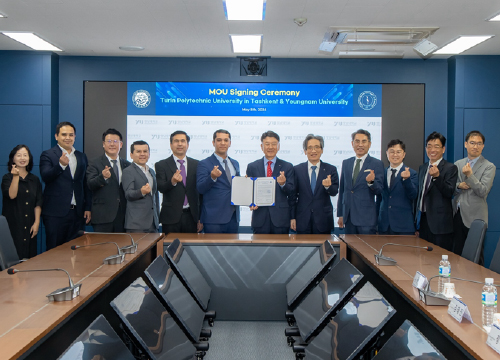
Turin Polytechnic University, the highest level engineering education institution in Uzbekistan Mutual cooperation, including operation of educational programs We decided to expand academic exchanges, including joint research activities between professors and students. [May 10, 2024] <Yungnam University and Turin Polytechnic University in Tashkent signed a business agreement to operate educational programs> (From the sixth from the left, President Tuychiyev Olimjon Alijonovich and President CHOI Oe-chool)> YU (President CHOI Oe-chool) and Turin Polytechnic University in Tashkent, Uzbekistan, signed a mutual cooperation agreement to operate educational programs and 2+2 joint degree programs. Officials from both universities including President Tuychiyev Olimjon Alijonovich of Turin Polytechnic University in Tashkent, Vice-Chancellor Yusupov Jalolliddin, Director Karimov Khojakbar for External Relations, and Director Sultanov Mansurbek for Sultanov Mansurbek Innotechno Park as well as President CHOI Oe-chool of YU, Vice-President PARK Seung-woo for Education and Innovation, Vice-President HEO Chang-deok for International Education, Director LEE Chun-young of International Student Recruitment Support Group attended the agreement signing ceremony held at YU in the morning of the 8th. Turin Polytechnic University was found in 2009 with investment by the Ministry of Education of Uzbekistan and Uzbekistan Automobile Association and currently has about 1,900 students in 9 departments. In 2015, it became the first Uzbek engineering university to acquire the ISO 9001:2008 standard and is now evaluated as the highest level engineering and technology education institution in Uzbekistan. Following the conclusion of this agreement, the two universities agreed on: ▲ Mutual cooperation in operating educational programs, ▲ Cooperate planning and implementation of 2+2 joint degree programs, ▲ Joint research activities, ▲ Exchange of academic materials and academic publications, ▲ Exchange of faculty for research, lectures, and discussions, and ▲ Exchange of graduate students and undergraduate students for research. <President Tuychiyev Olimjon Alijonovich and President CHOI Oe-chool signed the agreement.> President Tuychiyev Olimjon Alijonovich, who served as Vice-Minister of Innovation and Development of Uzbekistan and Director of the Innovative Development Agency of the Ministry of Higher Education, Science and Innovation and took office as President of Turin Polytechnic University this year, said, “Today’s exchange agreement with YU is a great help to the development of both universities and this will be an opportunity for further development of close relationship between the two countries. We expect that there will be synergy effect through exchanges in specialized fields of YU, which has a long history and tradition, and Turin Polytechnic University’s education and research know-how.” President CHOI Oe-chool of YU said, “I am glad that YU, which has received excellent evaluations in various world university evaluations, and Turin Polytechnic University, which has an excellent educational infrastructure in the field of engineering, can cooperate together. Since last year, we have started exchanges with five major public and private universities in Uzbekistan and are actively carrying out exchanges, such as opening of Department of Saemaul Studies and training of four professors from Department of Saemaul International Development of Park Chung-hee Graduate School of Saemaul. Regardless of nationality, our job is to educate talented people well. With the opportunity of today, we hope to go beyond sharing existing educational experiences and create a new educational paradigm, and YU will make its best endeavors.” Meanwhile, YU has been consistently interacting with the universities in Uzbekistan to cultivate talents who will contribute to the development of human society and to establish a bridgehead for the expansion of global education. In June last year, a visiting delegation from YU led by President CHOI Oe-chool visited five major universities, including Tashkent State University of Economics in Uzbekistan, which is considered the best in Central Asia, and signed exchange agreements. After the agreement, 2+2 dual degree system has been being operated with Tashkent University of Information Technologies (TUIT) from September last year and Samarkand State University established the Saemaul Department opened Department of Saemaul Studies in August last year and recruited new students with operation of dual degree system with YU. Starting in April of this year, they opened a major course taught by a YU professor for local students and began online lectures. In addition, they are expanding the scope of exchanges with universities in Uzbekistan, such as holding an academic symposium with Bukhara State University, Samarkand National University, and YU Museum in January to engage in academic and cultural exchanges.
- PR team
- 2024. 05. 25
- 2024. 05. 10
- 2766
-
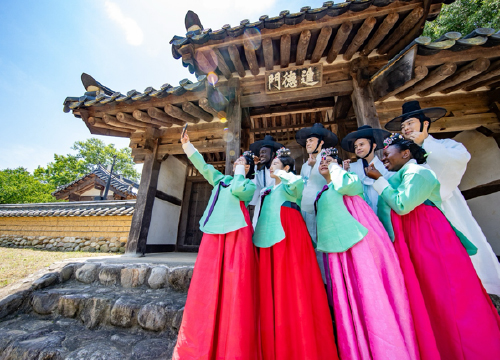
YU held an event to celebrate “Coming-of-Age Day” with international students. Providing an opportunity to understand Korean culture by experiencing traditional Korean rituals at Folk Village [May 17, 2024] At 10 a.m. on the 17th, foreigner students gathered at Gugyeseowon in YU Folk Village wearing traditional hanbok, hats, and hairpins. YU (President CHOI Oe-chool) prepared a traditional coming-of-age ceremony experience event with foreign students ahead of the 52nd ‘Coming-of-Age Day’ (the third Monday of May every year) on the 20th. At the traditional coming-of-age ceremony on this day, a total of eight male and female students, including six foreigner students from Uzbekistan, Cambodia, Ghana, Indonesia, Nigeria, and Myanmar wore the dopo and dangui and performed the “Gwanrye” and “gGyerye” ceremonies. Gwanrye is a Korean traditional coming-of-age ceremony for male persons from 15 years to 20 years to wear topknots and crowns with invitation of high learning and virtue guests. Gyerye is a ceremony to declare adult girls by loosening the hair of young girls and by making ponytails with insertion of hairpins. Foreigner students wore Korean traditional clothes and enjoyed the coming-of-age ceremonies of Gwanrye and Gyerye. Quaque Johnson (second class master’s degree student at YU Park Chung-hee Graduate School of Saemaul) from Ghana participated in the customary ceremony and said, “It was a very interesting and enjoyable time to experience Korean traditional culture. I want to experience various Korean cultures and build many memories while studying abroad.” Director Lee Eun-jeong of YU Museum, who hosted the coming-of-age ceremony on this day, said, “I hope that it will be an opportunity to think once again about the pride and responsibility of being an adult by directly experiencing Korean traditional rituals. Foreigner students would have a deeper understanding of Korean culture. I hope it will remain as a good memory during your time studying abroad.”
- PR team
- 2024. 05. 25
- 2024. 05. 17
- 2450
-
- PR team
- 2024. 05. 25
- 2024. 05. 14
- 2510