-
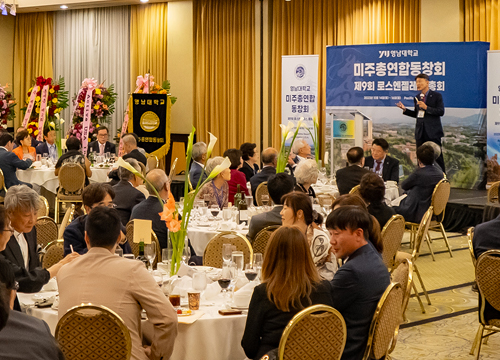
The 9th Annual General Meeting of American General Alumni Association was held in Los Angeles, USA from the 14th to the 16th. $5,000 of alma mater's development fund and $4,000 of scholarships to alumni studying abroad in the US The 10th regular general meeting will be held in Chicago, USA in 2025 [October 25, 2023] <Group Photo of 9th Annual General Meeting of YU’s American General Alumni Association> YU (President CHOI Oe-chool) confirmed its strong alumni power in the USA. Yu’s American General Alumni Association (Chairman JEON Heung-won, Student ID 58, College of Pharmacy) held 9th regular general meeting at Pacific Palms Resort in Los Angeles, USA from October 14 to 16, local time. LEE Don (Student ID 73, Architecture), who served as the first chairman of YU’s American General Alumni Association and is the representative director of Active USA Inc. takes in charge of Preparation Chairperson of the regular general meeting and more than 150 YU alumni working in whole areas of the USA including JEON Heung-won (8th Chairman of YU’s American General Alumni Association, Student ID of Pharmacy), PARK Chang-ho (Chairman of Chicago Alumni Association, Student ID 75 of Electricity), OH Jeong-ho (Chairman of Toronto Alumni Association, Student ID 64, Textiles), and SHIN Min-ho (Chairman of San Francisco Alumni Association, Student ID 73, Physical Education) participated. President CHOI Oe-chool and Special Vice-President HEO Chang-deok also participated in the regular general meeting and President CHOI Oe-chool explained main performances of YU and requested continuous interest and support of the alumni through his special lecture on “YU's 76 Years of Status, Opportunities, and Challenges.” <President CHOI Oe-chool gave a special lecture on “YU's 76 Years of Status, Opportunities, and Challenges” at the regular general meeting of American General Alumni Association> Especially, at this regular general meeting, American General Alumni Association donated $5,000 as alma mater's development fund.Also, $4,000 of scholarship was awarded to two juniors studying in the USA.At the scholarship award ceremony on this day, KIM Tae-ik (35), who graduated from the Department of Psychology in February 2013 and is currently in the doctoral program in psychology at the University of Missouri Columbia, and YOON Jeong-won (35), who graduated from the Department of Chemical Engineering in February 2022 and is currently enrolled in the doctoral course of in chemical and biomolecular engineering at Ohio State University received $2,000 of scholarship of $2,000, respectively. At the regular general meeting, alumnus LEE Don, who served as Preparation Chairman, was elected as the 9th president.New Chairman LEE Don said, “I am proud that many active alumni from all over the Americas gathered at the regular general meeting held six years after the pandemic and can feel the power of YU’s alumni again. Next year will be the 77th anniversary of the school’s opening. North American alumni will lead construction of a statue of former President PARK Chung-hee, the founder of the university and the person who achieved the Miracle on the Han River, on the campus of our alma mater.” YU’s American General Alumni Association held its inaugural general meeting in LA in October 2002 and ten regional alumni associations work in the America including Chicago, New York, Washington, San Francisco, Dallas, Vancouver, and Toronto. The regular general meeting, which has been held every two years, was held six years after the 8th regular general meeting in 2017 due to COVID-19 and the 10th regular general meeting will be held in Chicago, USA in 2025. <President CHOI Oe-chool gave a special lecture at the 2023 Gyeongsangbuk-do North America Economic Forum on “Measures to pioneer new markets using Korea’s experience.”> Meanwhile, President CHOI Oe-chool, who visited the USA to attend the regular general meeting, attended “21st World Korean Business Convention” held at the Anaheim Convention Center before attending the general meeting. President CHOI attended “2023 Gyeongsangbuk-do North America Economic Forum” hosted by Gyeongsangbuk-do during the conference schedule and gave a special lecture on “Measures to pioneer new markets using Korea’s experience” to over 300 people, including Gyeongsangbuk-do Governor LEE Cheol-woo, KIM Young-wan Los Angeles Consul General, Dave Min California Senator, key attendees of the World Korean Business Convention, and Korean-American businesspeople. President CHOI Oe-chool said, “The pioneering spirit and challenging spirit of Korean compatriots, including YU alumni in the America, are the driving force that made Korea an advanced country today. High-ranking officials from Indonesia and Cambodia recently visited YU and requested transmission of Saemaul Studies and leaders from developing countries have visited YU, showing that the demand for Saemaul Studies and Saemaul Undong is being increased by international communities.YU, which has academically translated Korea’s development experience from a least developed country to a developed country and the Saemaul Undong, will continue its role and efforts at the university level to promote economic development and overcome poverty in developing countries.” <In May, President CHOI Oe-chool gave a special lecture on “Globalization of Saemaul Undong to develop new markets” to over 250 CEOs invited by Korea International Trade Association.> This is not the first time that President CHOI Oe-chool met businesspeople. In May, President CHOI Oe-chool gave a special lecture on “Globalization of the Saemaul Undong to develop new markets” to over 250 CEOs and officials invited by Korea International Trade Association and received great response from them on the theme that YU will serve as a stepping stone in expanding Korea's economic territory.
- PR team
- 2023. 11. 02
- 2023. 10. 25
- 5703
-
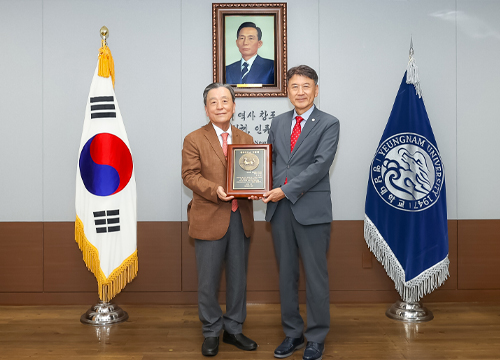
Selection of alumni who contributed in development of the university, among individuals and institutions that donated large amounts of development funds Serving as Chairman of YU College of Pharmacy Alumni Association and leading fundraising activities for the new construction of the College of Pharmacy Until now, over KRW 101 million of donation to the alma mater's development fund... Continuous social contribution activities [October 13, 2023] <Chunma Honors Certification Plaque Awarding Ceremony (From the left, Chairman LEE Soo-geun and President CHOI Oe-chool)> YU (President CHOI Oe-chool) selected LEE Soo-geun, chairman of the College of Pharmacy Sponsorship Scholarship Association, as a member of “Chunma Honors” and awarded him the certification plaque. “Chunma Honors” is a donor courtesy program which was established by YU in 2020.It was established to honor major donors who contributed in development of the university and to spread a new donation culture at the university. Chairman LEE Soo-geun is an alumnus of Student 67 of YU’s Department of Pharmacy, served as the chairman of Pharmacy Alumni Association for four years from 2014 to 2018, and currently serves as the chairman of the Board of Directors of the College of Pharmacy Sponsorship Scholarship Association.While serving as the Chairman of the Alumni Association of College of Pharmacy, he led the “KRW 5 billion fund raising project for construction of the new building for College of Pharmacy” and made a great contribution in construction of a new building of College of Pharmacy equipped with state-of-the-art facilities.Chairman LEE has continuously donated development funds, starting with Sponsorship Fund for College of Pharmacy in 2005, and has donated a total of 101 million won to date. Chairman LEE Soo-geun attended Chunma Honors Certification Plaque Award Ceremony on the 6th and said, “When I took office as the Chairman of Alumni Association of College of Pharmacy in 2014 at the suggestion of my teacher, Professor JEONG Si-ryeon (currently Professor Emeritus of YU), there were difficulties because I had a big goal of building a new building for College of Pharmacy.With the interest and support of numerous pharmacy school alumni, we have succeeded in raising a development fund, and I feel proud when I see my juniors currently studying at the newly built pharmacy school. I have been practicing sharing to give a small repayment for what I learned and gained at my alma mater. Thank you for giving me the honor of being called “Chunma Honors.”I will continue providing support so that we can contribute in development of our alma mater and our juniors.” President CHOI Oe-chool of YU said, “On behalf of the university, I would like to thank Chairman LEE Soo-geun, who served as the president of the Alumni Association of College of Pharmacy and is currently the chairman of the scholarship society for juniors of the College of Pharmacy, and has always taken the lead in the development of alumni as well as for his alma mater and his juniors. Based on the continuous researches and education by the professors of College of Pharmacy and continuous interest and love by Chairman LEE Soo-geun and alumni, the highest competition rate of 39.3 to 1 was recorded in YU by Faculty of Pharmacy in application reception for the 2024 academic year held in September.We will do our best to help students grow into global talents who contribute to human society, as Chairman LEE, who is dedicated in cultivating talents and contributing to society.” <Chunma Honors Certification Plaque Awarding Ceremony (From the third from the left, President CHOI Oe-chool and Chairman LEE Soo-geun)> YU selects donors who have contributed greatly for development of the university and have great social recognition and influence among individuals and institutions (groups) that have donated more than KRW 100 million for development funds and grants them membership of “Cheuma Honors.”Until now, over 100 individuals and organizations (institutions) have been selected as members and YU is holding a certification plaque presentation ceremony for the individuals and organizations selected as the members. YU established and operates a donor courtesy program, including awarding certification plaques to Chunma Honors members and invites them as foreign guests to major university events.
- PR team
- 2023. 11. 02
- 2023. 10. 13
- 5540
-
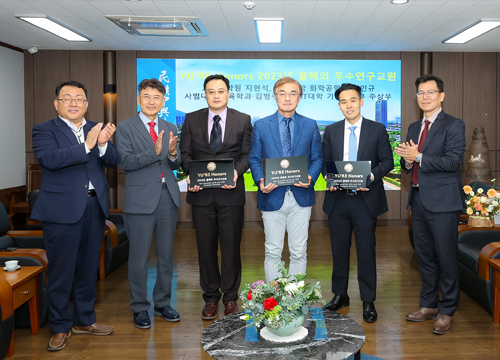
From 2021, a program to honor professors with excellent research results Professor JI Hyeon-seok (Graduate School of Education), KIM Byeong-ju (Education), KIM Min-gyu (chemical engineering), and JOO Sang-woo (mechanical engineering) Every year, research administrative support to each mid-career researchers [October 12, 2023] <Professors selected as “2023 YU’RE Honors” outstanding research faculty of the year> (From the second from the left, President CHOI Oe-chool, Professor JI Hyeon-seok, Professor JOO Sang-woo, and Professor KIM Min-gyu) On the 5th, an award ceremony for Outstanding Research Faculty of the Year was held at YU (President CHOI Oe-chool). YU intends to select excellent faculty through YU’RE Honors Program and to strengthen research competitiveness through support. “YU’RE Honors” was adopted in 2021 to discover professors with excellent research results, publicize their achievements to the public, and maximize research capabilities through administrative and financial support so that professors can focus on researches. Divided into new and mid-career researchers, each two professors with outstanding research achievements in the previous year are selected, for a total of four researchers each year. At this year’s awards ceremony, plaques and awards were awarded to four “2023 Outstanding Research Teachers of the Year.”In the young researcher category, Professor JI Hyeon-seok of the Graduate School of Education and Professor and KIM Min-gyu of the Department of Chemical Engineering were selected and, in the mid-career researcher category, Professor KIM Byeong-ju of the Department of Education and Professor JOO Sang-woo of the Department of Mechanical Engineering were selected. Professors selected as “Excellent Research Faculty” receive priority support for research expenses and administrative support services through the placement of dedicated staff.Also, if a person is selected as an “Outstanding Research Faculty” three times, he or she will be permanently posted in the “Industry-Academic Cooperation Hall of Fame.” President CHOI Oe-chool said, “This year, YU is consistently showing its potential by ranking 8th in Korea in the “Leiden Rankings” a world university evaluation based on research capabilities that can measure a university’s research performance and quality. Especially, we have been recognized for our research capabilities in various fields, including ranking first in the country in the mathematics and computer fields for 9 consecutive years, 9th in the country in the life and earth sciences field, and 17th in the natural sciences/engineering field. Professors have been devoted to research. The fruits of our efforts are the source of YU’s strength, which has world-class research capabilities.In order to raise the status of YU and foster global talent, the university will actively support faculty research infrastructure support and continuous system maintenance.” Professor JI Hyeon-seok, who was selected in the young researcher category, received an academic master's and doctoral degree from The University of Tokyo, Japan, was appointed as a professor at YU in September 2019, and has been implementing Science and Engineering Academic Research Support Project and Regional Outstanding Local University Scientist Support Project, etc.Professor JI escaped from the general method to apply simple exercise methods without sufficient macroscopic evidence to form “healthy skeletal muscles” on such topics as cancer, exercise, and health and is conducting researches related with search of convergence methods as fundamental resolutions in a microscopic viewpoint such as validation of candidate gene groups with use of various evidences with the subject of “Muscle plasticity modulating molecules.” Professor KIM Min-gyu received a doctorate in chemical engineering from The Ohio State University, USA, and was appointed as a professor at YU in September 2020.He was recognized as a leading researcher in the field of cryogenic methane activation research by publishing a paper in the world-renowned journal SCIENCE in 2017, and continued to conduct follow-up research in the top journals in the field of catalysts, ACS catalysis, Applied Catalysis Environmental: B, Journal of American Chemistry Society ( JACS) and other research papers have been published.In the three years since his appointment, he has published 36 research papers and has been actively engaged in research activities, publishing four papers with an impact factor (IF) of 20 or higher in the past year.Professor KIM was recognized for these research achievements and presented his research as an invited speaker at the 2022 ACS Fall Meeting.Recently, he served on the organizing committee of the Korea-Vietnam Separation Section Symposium of the Korean Society of Chemical Engineers. Professor KIM Byung-joo, who was selected in the mid-career researcher category, received a doctorate from Seoul National University and was appointed as a professor at YU in September 1995.Professor KIM Byung-joo has published over 250 academic journal papers until now and is recognized as an outstanding researcher in the field of education finance and policy. Academically, he has served as academic chairperson and editor-in-chief of academic journals for major academic societies in the field of education, including the Korean Society of Education, and currently serves as president of The Korean Educational Administration Society.In the field of education policy, he served as the director of the Higher Education Policy Research Center designated by the Ministry of Education, led policy research in the field of higher education, and, recognition of his outstanding ability in the field of education policy and finance, leads the theory and practice in important national education policy areas by serving as the chairman of the Private University Financial Diagnosis Committee and the Ministry of Education's Reserve Consolidation Advisory Group as an expert member of national education plan of National Education Committee, Chairman of Private University Finance Diagnosis Committee of the Ministry of Education (Korea Foundation for the Promotion of Private School), and Chairman of Reserve Consolidation Advisory Group of the Ministry of Education, etc. Professor JOO Sang-woo received his bachelor's and master's degrees from Seoul National University and his doctoral degree from the University of Michigan-Ann Arbor. He later served as a professor at the University of Illinois at Chicago and Wayne State University in the United States, and was appointed to YU in 1995.Starting with research in the field of fluid dynamics, he expanded his scope to the nano field and published more than 600 SCI papers, which were cited more than 17,000 times. He served as an expert member of the National Science & Technology Commission, a technical expert member of the National Energy Commission, and an expert member of National Research Foundation of Korea, and a member of Korea Academy of Science and Technology.He also serves as a visiting professor at Cambridge University in the UK and Augsburg University in Germany, and has been conducting various research at the NASA Lewis Research Institute and the University of Tennessee in the USA.
- PR team
- 2023. 11. 02
- 2023. 10. 12
- 5007
-
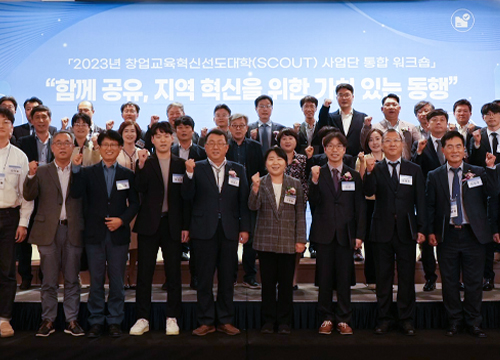
Workshop with the theme of “Sharing together, valuable companionship for regional innovation” Sharing entrepreneurship education content and establishing a cooperation system for entrepreneurship semester system YU leads the advancement of entrepreneurship education at local universities as a host university in the Daegyeong and Gangwon regions [October 12, 2023] <YU held a workshop for STARTUP Co-Op University for Transition of edu> YU (President CHOI Oe-chool) held a workshop for STARTUP Co-Op University for Transition of edu at the Inter-Burgo Hotel in Daegu from the 5th to the 6th. It is an event to announce the start of STARTUP Co-Op University for Transition of edu and more than 200 persons from 35 universities and local governments attended. STARTUP Co-Op University for Transition of edu (SCOUT) is a project supported by the Ministry of Education and the National Research Foundation of Korea for community entrepreneurship education by expanding entrepreneurship education base universities, establishing a foundation for entrepreneurship education in each region, and establishing a collaboration system with local governments. It's business.The total project period is 5 years, the selected universities will receive KRW 750 million in support every year, and YU is the host university of the Daegyeong-Gangwon consortium (YU, Gangneung-Wonju National University, Keimyung University, Andong National University, and POSTECH) to lead the advancement of entrepreneurship education at local universities. This workshop was held with the subject of “Sharing together, valuable companionship for regional innovation.”Various opinions were shared on ▲Cooperation to create and revitalize the entrepreneurship ecosystem ▲Sharing entrepreneurship education contents of the SCOUT business group across the country and ▲Establishment of a cooperation system for the entrepreneurship semester system.This event is highly meaningful in the respect that it announced the start of STARTUP Co-Op University for Transition of edu as a nationwide hub for shared growth in startup education.Also, training to strengthen the capabilities of practitioners was also conducted through the startup education innovation forum and SCOUT Value-Up Academy with the agenda of “Startup education to lead regional innovation in the Local Era.” The 35 universities participating in STARTUP Co-Op University for Transition of edu will share and collaborate with each university's capabilities to advance the entrepreneurship education ecosystem in each region, performing various key roles such as establishing an entrepreneurship-friendly system, bridging the gap in entrepreneurship education, and establishing a shared collaboration platform.Especially, it is expected to show a leading model for local startups in connection with the Regional Innovation-Centered University Support System (RISE). Professor JEON In of YU, head of the Daegyeong-Gangwon Area STARTUP Co-Op University for Transition of edu, said, “We hope that all local universities, local governments, and startup-related organizations participating in the project will join forces to build a startup-friendly cooperation system based on social trust. YU will also do its best to achieve its business goals as the host university in the Daegyeong-Gangwon regions based on its startup support and educational know-how
- PR team
- 2023. 11. 02
- 2023. 10. 12
- 4682
-
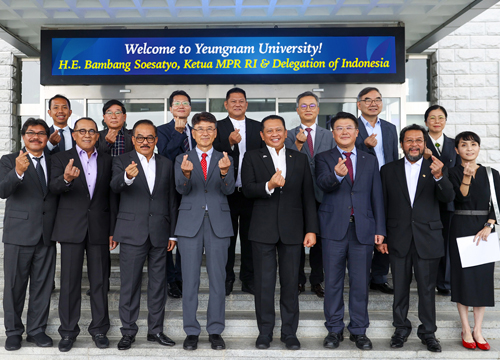
Chairman of the Indonesian Senate also visited YU following the Chairman of the Foreign Affairs Committee of the Cambodian National Assembly Request for guidance and support to establish the Department of Saemaul Development and Saemaul Education and Training Center for rural development and for overcoming poverty The 50th anniversary of the establishment of diplomatic relations between Korea and Indonesia, aiming at developmental relationship based on mutual understanding and cooperation [September 25, 2023] On the 20th, a delegation of members of the National Assembly, including Indonesian Senate President Bambang Soesatyo, and university presidents visited YU (President CHOI Oe-chool) and requested sharing of YU's know-how on Saemaul education to cultivate talents that are the keys for national development.This is already the second time in a week that the Chairman of the Foreign Affairs Committee of the Cambodian National Assembly, etc. visited YU to establish the Department of Saemaul Studies at a new university in Kampong Thom and request support for training Saemaul leaders. Bambang Soesatyo, Chairman of the Indonesian Senate, is a powerful politician who ranks third in the national hierarchy.He currently serves as the Chairman of the National Council, which oversees the National Representative Meeting and the Regional Representative Meeting, and has held key positions including National Assembly Budget Committee Member, House Chairman, and House Speaker.They met President CHOI Oe-chool of YU and said, “Saemaul Undong and Saemaul education is essential programs for Indonesia, which has national tasks of rural development and overcoming poverty. I hope YU to play an active role in transferring the know-how on Saemaul education and expanding exchanges between the two countries.” In response, President CHOI Oe-chool said, “The Saemaul Undong advocated by President PARK Chung-hee is a national development policy that seeks to change the minds of local residents, to improve the environment, and to overcome poverty by increasing income and Saemaul Studies is the academic form of it. Many countries are visiting YU to share Korea’s experience in development and the achievements of YU’s Saemaul Studies education. We will do our best to convey the experience and know-how that YU has accumulated over the years.” At the business agreement ceremony between Indonesia's Universitas Perwira Purbalingga and YU, the two universities promised cooperation to ▲ establish a Saemaul Development Department ▲ develop a 2+2 joint education program and ▲ establish Saemaul Education Training Center, etc.At the signing ceremony, Eming Sudiana, President of Universitas Perwira Purbalingga, strengthened, “Although our university is a new university, our biggest educational goal is to cultivate talents for the development of the local community.To achieve this, YU’s Saemaul education know-how is needed.” Meanwhile, Senate President Bambang Soesatyo strengthened in a special lecture to about 150 students of YU's Global Talent College following the agreement ceremony that mutual understanding and cooperation between future generations is more important for the next step in the relationship between the two countries as they celebrate the 50th anniversary of the establishment of diplomatic relations.
- PR team
- 2023. 10. 12
- 2023. 09. 25
- 6712
-
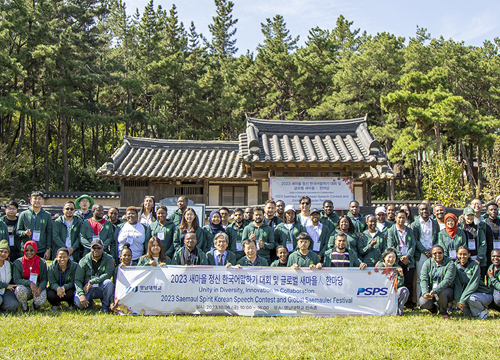
PSPS (Park Chung Hee School of Policy and Saemaul) held Global Cultural Festival for Experience in Korean Language and Culture. “Saemaul Spirit Korean Speech Contest” and presentation of “My life in Korea,” etc. for foreigner students Enjoyed the festival with traditional dances and songs of the world as well as Korean traditional plays including stick throwing [October 06, 2023] PSPS of YU (President CHOI Oe-chool) held “2023 Saemaul Spirit Korean Speech Contest & Global Saemauler Festival.” It is a global cultural festival designed to help international students to enhance their understanding of traditional Korean culture and Korean language, share their feelings about Korea, and strengthen their sense of belonging and connection. In the Saemaul Spirit Korean Speaking Contest held at the YU Folk Village on the morning of the 6th, 12 international students from 7 countries, including Myanmar, Tanzania, and Ghana, attending Park Chung-hee Graduate School of Saemaul participated.Foreign students made Korean presentations with such subjects as “What is Park Chung Hee School of Policy and Saemaul for me?” and “My life in Korea,” “The happiest time in my life,” etc. <A foreigner student of PSPS makes a presentation in Saemaul Spirit Korean Speech Contest> Herrera Quintero Maria Del Rosario from Panama, who presented on the topic of ‘My Life in Korea’, took first place in the competition. Maria said, “I think that as a result of focusing on studying my Korean language while preparing for the Korean speaking contest, could get this good result. Preparing for this topic gave me an opportunity to reflect on my time studying abroad and strengthen my will to study. I want to make many memories while enjoying traditional Korean games with my friends who are studying with me.” <Winners of Saemaul Spirit Korean Speech Contest> Next to Saemaul Spirit Korean Speech Contest, Global Saemauler Festival was held in the afternoon. More than 80 persons consisting of students and professors of PSPS and students of YU Saemaul Club had the opportunities to enjoy Korean traditional plays such as stick throwing, Jegi kick, hoop roll, and arm wrestling, etc. In addition, foreign students from around the world had the time to show off and understand other cultures by performing traditional dances and songs of their countries, wearing traditional costumes, and putting on a fashion show. <Foreigner students of PSPS enjoy stick throwing, a Korean traditional play> <Foreigner students of PSPS enjoy Jegi kick, a Korean traditional play> Director LEE Byeong-wan of YU Park Chung-hee Graduate School of Saemaul, who organized this event, said, “It would be an opportunity for foreign students to improve their Korean language skills by writing and presenting in Korean what they felt and experienced while studying abroad in Korea. I hope that their understanding of Korean culture increases and vitality is provided for their abroad-studying life in a foreign country by experiencing Korean culture with professors and friends at today’s festival. I hope that the Saemaul major knowledge and experience gained at Park Chung-hee Graduate School of Saemaul will be of great help to international students when they return to their respective countries.” <Foreigner students of Park Chung Hee School of Policy and Saemaul enjoy Korean traditional culture, Samulnori performance> Meanwhile, Park Chung Hee School of Policy and Saemaul (PSPS) of YU was established in 2011 to cultivate Saemaul leaders of developing countries.Foreign students studying in PSPS consist of public officials planning policies in respective countries, employees of public institutions, social activists, and professional workers, etc. differently from students of faculties or graduate schools. They study Korean language and complete master's degree course during a relatively short 18-month study period and YU has been providing Korean Speech Contest and Korean culture experience events to supply them with wider experiences in Korean culture.Now, 58 foreigner students from 23 countries such as Cambodia, Indonesia, Rwanda, Ethiopia, Panama, and Liberia, etc. are studying and, until now, 765 persons from 67 countries received master’s degree of Saemaul Study and are working as main policy establishers, international development professionals, and Saemaul Undong leaders in central ministries/offices, public institutions, and international development NGOs, etc.
- PR team
- 2023. 10. 12
- 2023. 10. 06
- 6474
-
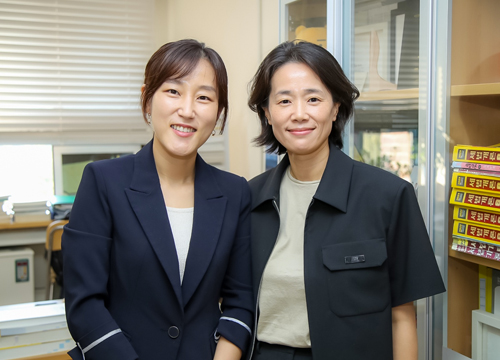
Selection as a new author for excellent research paper in accounting field by Korean Accounting Association Reveal of the importance of financial statement ‘other’ accounts was revealed for the first time [September 26, 2023] Dr. WOO Hye-jin (36, research faculty at YU Business Research Institute) from Department of Accounting and Taxation of YU (President CHOI Oe-chool) won 2023 Accounting Dissertation Award of Korean Accounting Association. <From the left, Dr. WOO Hye-jin and Professor HONG Young-eun> The Korean Accounting Association is the most authoritative academic organization in the accounting field. It was established in 1973 for the purpose of developing Korean accounting research and education and sound research activities in accounting. It selects excellent theses and gives thesis awards every year to promote accounting research by new researchers. Dr. WOO Hye-jin’s thesis <Why should information users be interested in 'other' account subjects after the introduction of K-IFRS?> is the first study to show that the ambiguity and abstractness of the classification standards contained in “other” account subjects is used strategically by managers as management's discretion in presenting financial statements has expanded, because Korea International Financial Reporting Standards (hereinafter referred to as K-IFRS) established by Korea Accounting Standards Board in 2007 to meet International Financial Reporting Standards (IFRS) have been mandatory for all listed companies since 2011. Currently, financial statement account items that are displayed in different ways for each company are provided in a uniform manner in the existing database system.In this study, the reliability and accuracy of the data was increased by collecting “other” account subject data used differently by individual companies using web crawling rather than using account subject classification in a standardized database system.In addition, after the introduction of K-IFRS, which is an important standard for calculating accounting information, it is significant to clarify that information users should be careful when making decisions using accounting information that includes “other” items. Dr. WOO Hye-jin said, “I would like to thank my advisor and the professors of the Department of Accounting and Taxation who taught me a lot during the research process. In connection with this doctoral thesis, I was selected for the National Research Foundation of Korea’s Humanities and Social Sciences Academic Research Professor Support Project and am currently working on “Other Account Subjects.” We will also faithfully pursue research related to ‘information usefulness.” Professor HONG Young-eun of YU Department of Accounting and Taxation, the advisor, said, “After the introduction of K-IFRS, the research results that contributed to increasing the reliability and accuracy of accounting information seems to have been recognized by the academic community. We are making more efforts to produce excellent talents in the field of accounting.”
- PR team
- 2023. 10. 12
- 2023. 09. 26
- 6292
-
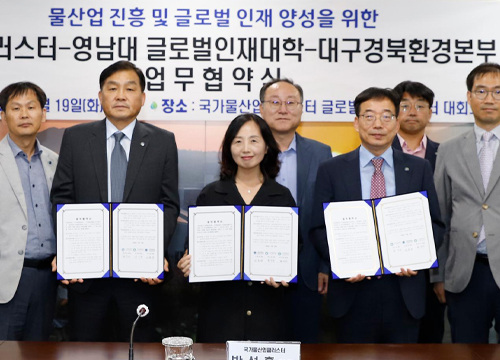
Gathering the capabilities of each institution to cultivate global talent and promote the global water industry Establishment of various cooperation networks through human and material exchanges [September 21, 2023] Global Leaders College of YU (President CHOI Oe-chool) concluded a multilateral MOU with Korea Water Cluster Project Team (Director PARK Seok-hoon) of Korea Environment Corporation and Daegu-Gyeongbuk Environment Headquarters (Director HWANG Seung-man) of Korea Environment Corporation on 2nd floor of Global Business Center of Korea Water Cluster Project Team on September 19th. <YU Global Leaders College concluded a multilateral business agreement with Korea Environment Corporation.> Following the conclusion of this agreement, each organization greed to gather capabilities to ▲Establish a cooperation system to promote the water industry through industry-academia cooperation, ▲Cooperate on establishing customized capacity building programs for domestic and foreigners, ▲Jointly develop various educational programs to foster local universities, and ▲Establish various cooperation networks for mutual development of local communities through human and material exchanges. HWANG Seung-man, head of the Korea Environment Corporation's Daegu-Gyeongbuk Environment Division, said, "As a public institution specializing in the national water industry that leads water management technology innovation, we have the highest level of capabilities. With this agreement, we have launched an Official Development Assistance (ODA) project. We expect to promote mutual cooperation, such as developing overseas markets for water companies and nurturing global key talent in the water industry,” he added.” Dean LEE Chun-young of YU Global Leaders College said, “By signing this agreement, the foundation has been laid for mutual development between YU, which has abundant global human resources and excellent educational programs, and Korea Environment Corporation, a public institution specializing in the water industry. We will continue to make efforts to cultivate excellent professionals with global competitiveness.”
- PR team
- 2023. 10. 12
- 2023. 09. 21
- 6075
-
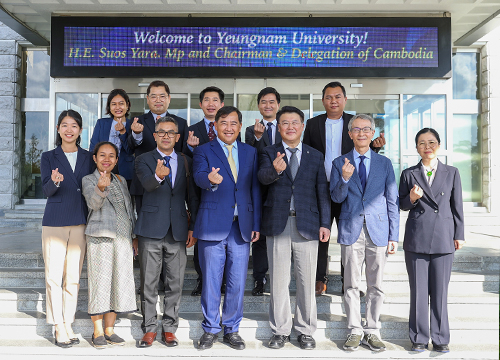
Visiting team of the Chairman of Foreign Affairs Committee of Cambodian National Assembly, a request for cooperation in establishment and operation of Saemaul University to YU Establishment of Saemaul University in the center of seven regions adjacent to Tonle Sap, the lifeline of Cambodia Proposal to train Saemaul leaders in collaboration with YU and Royal University of Phnom Penh [September 19, 2023] <Sixth from the left: SUOS Yara, the Chairman of National Assembly Foreign Affairs Committee and President CHOI Oe-chool> “Cambodia intends to write a new history with the launch of a new government. In order to achieve the goal of creating a high-income country by 2030, the most urgent need is to advance agriculture, which is the basis of Cambodia's industry, and modernize rural areas, which are the basis of life, and cultivate human resources. For this, a university was established to introduce the talent training method of the Saemaul Undong to Cambodia.We request support for the talent training know-how accumulated by YU in order to train 1,500 Saemaul experts within two years.” In the afternoon of the 18th, SUOS Yara, the Chairman of Cambodian National Assembly Foreign Affairs Committee, visited YU (President CHOI Oe-chool), met President CHOI Oe-chool, and requested an active role in cultivating Cambodian talents. He is currently serving as the Chairman of Cambodian National Assembly Foreign Affairs Committee, is evaluated as Cambodia's next-generation leader, and said, “The university buildings and infrastructure are already provided in Kampong Thom, the center of the seven regions adjacent to Tonle Sap, the lifeline of Cambodia. Now, the key is to characterize the university as a university to train Saemaul experts. As cooperation with the Royal University of Phnom Penh, the most prestigious university in Cambodia, is possible, we ask YU to play a leading role in cultivation of Saemaul leaders in Cambodia. <Chairman SUOS Yara of National Assembly Foreign Affairs Committee> President CHOI Oe-chool of YU responded, “It’s the right time for Cambodia to take a leap forward, as Cambodian government has a strong will to develop agriculture and rural areas and overcome poverty. Based on the mutual trust built over the past 10 years, I will gladly share the know-how on Saemaul Undong accumulated by YU and on development of Korea.” This is the third visit by a high-level Cambodian team to YU. In 2014, Cambodian Deputy Prime Minister Yim Chhayly and other vice ministers from major government ministries visited YU to learn about Saemaul Undong and to request advice on the establishment and operation of Saemaul University and, in February of last year, officials from major government ministries, including Cambodia's Ministry of Foreign Affairs and International Cooperation, visited YU and had discussions on Saemaul international development cooperation plans and joint degree programs. <Chairman SUOS Yara of National Assembly Foreign Affairs Committee, fourth from the left in the front row> Meanwhile, President CHOI Oe-chool has been advising on policies to promote various projects in the rural development field in Cambodia since being appointed as an advisor to the Prime Minister of Cambodia in 2014.Previously, in 2011, YU established YU Park Chung-hee Graduate School of Saemaul (PSPS) and has provided support to about 50 Cambodian public officials and leaders to study for a master's degree in Saemaul Studies. The Department of Saemaul Economic Development was opened at a local university in Cambodia and the Department of Saemaul Economic Development was established through a dual degree system to provide high-quality educational opportunities.Due to such contributions, he received an honorary doctorate in education from a local university in August with the approval of the Cambodian Ministry of Education, and has continued his efforts to share Saemaul Undong with Cambodia for over 10 years.
- PR team
- 2023. 09. 26
- 2023. 09. 19
- 7457
-
Increase compared to the previous year, 23,497 people applied to recruit of 3,802 people The highest number of applicants ever for regular admissions “Faculty of Pharmacy” has the highest competition rate for general students at 39.3 to 1. [September 15, 2023] As a result of YU’s (President CHOI Oe-chool) closing of the application for admission for the 2024 academic year at 6 p.m. on the 15th, 23,497 people applied for 3,802 students (within the quota), recording an average competition rate of 6.18 to 1, with an increase compared to previous year. ( Competition rate for regular recruitment last year: 6 to 1) Although the number of applicants increased in this rolling recruitment compared to previous year, the competition rate increased, and for the first time in YU's rolling recruitment, the number of applicants recorded more than 25,000 (25,085 including quota). The fields of medicine and pharmacy, which have traditionally had high competition, showed high competition again this time.The highest competitive rate was recorded by Faculty of Pharmacy in the general student admissions process. As many as 668 people applied to recruit 17 people, recording the highest competition rate of 39.3 to 1.Faculty of Pharmacy also showed a high competition rate of 25.2 to 1, with 453 applicants for 18 recruits in the local talent screening process.In case of the Department of Medicine, 297 people applied to recruit 8 students for the general student screening, recording a ratio of 37.1 to 1, regional talent screening showed 13 to 1, and medical creative talent screening showed 26.1 to 1, with high competition rates in all screenings. In addition, in the general student selection, Department of Global Education showed 19 to 1, Department of Media and Communication showed 17.3 to 1, Department of Philosophy showed 12.7 to 1, Applied Chinese Interpretation and Translation Major showed 11.9 to 1, Department of Police Administration showed 11.8 to 1 in regional talent selection, Department of Horticulture and Life Science showed 10.2 to 1 in the screening for students with outstanding potential, Department of Psychology showed a high competition rate of 12.1 to 1, Department of Human Services showed 11 to 1, and Department of Clothing and Fashion showed 10.2 to 1. In the practical screening, Department of Physical Education major in Faculty of Physical Education recorded a high competition rate of 10.6 to 1. In terms of screening, 9,446 people applied for general student screening, which recruits 1,425 people, recording a competition rate of 6.6 to 1, and 5,509 people applied for regional talent screening, which selects 909 people, and high potential candidate screening recruits 836 people, with a ratio of 6.1 to 1. 5,847 people applied, showing a competition rate of 7 to 1. Meanwhile, YU's 2024 regular recruitment arts and physical education practical exam will be held on October 24 for Department of Physical Education, October 24-26 for the College of Arts, and the interview test (medical creative talent selection) will be conducted on October 14. Announcement of successful applicants will be done on November 10th for practical examinations and on December 15th for other examinations.
- PR team
- 2023. 09. 26
- 2023. 09. 15
- 7269